8 Not So Common Ways to Increase Collaboration in Teams
According to Cijaye DePradine
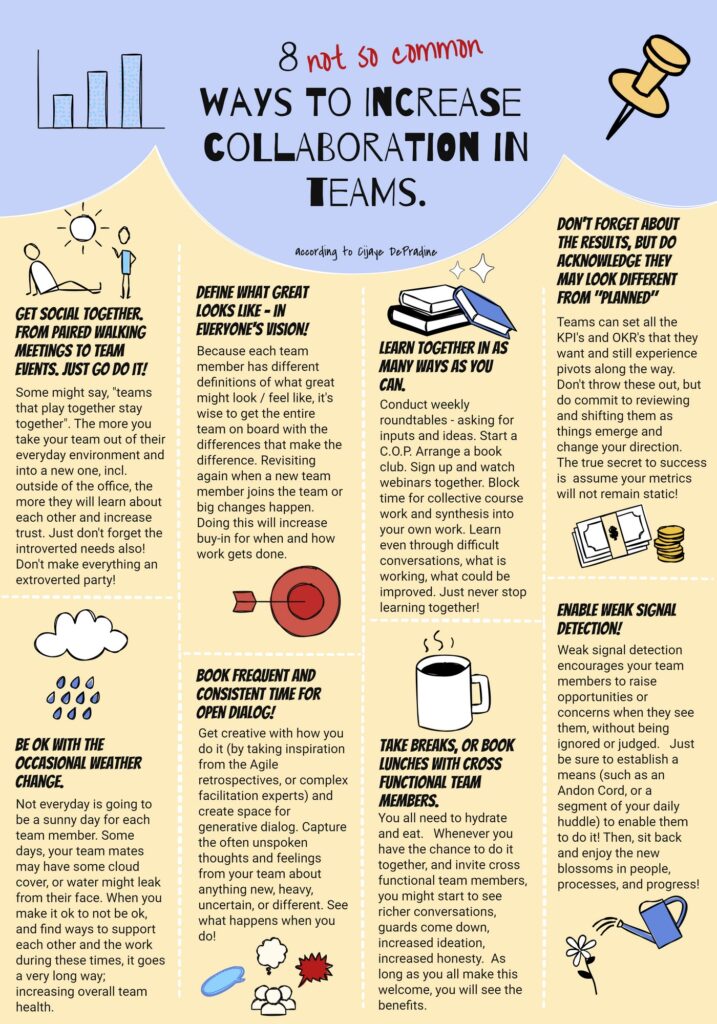
1. Get Social Together. From Paired Walking Meetings to Team Events. Just Go Do It!
Some might say, "teams that play together stay together". The more you take your team out of their everyday environment and into a new one, incl. outside of the office, the more they will learn about each other and increase trust. Just don't forget the introverted needs also!
One word of advice on behalf of the introverts and neurospicy folks out there - try to be more inclusive of their unique ways of being social.
For example, don't make everything an extroverted party. Some of us prefer and feel more connected when we are in smaller groups of 2 or 3, when we have a deep reflective question or prompt to explore together, or when we have a creative space to play in.
Another great way to include introverts and neurodiverse team or group members is to invite them to solve a problem, search for something interesting, or co-create / produce an artifact of sorts.
Yes, these different ways of getting social may sound very different to those who are neurotypical and yet - in a world built mostly for neurotypicals and extroverts, it is a wonderful thing when there is space made for others too.
2. Be OK with the Occasional Weather Change.
Remember the impacts of COVID19? Or the human rights movements? What about all of the current economic and war time circumstances. Of course there are going to be lasting impacts on some who are deeply impacted even to this day.
Not everyday is going to be a sunny day for each team member. Some days, your team mates may have some cloud cover, or water might leak from their face. When you make it ok to not be ok, and find ways to support each other and the work during these times, it goes a very long way; increasing overall (and long term) team health.
3. Define What Great Looks Like – In Everyone's Vision!
Because each team member has different definitions of what great might look / feel like, it's wise to get the entire team on board with the differences that make the difference. Revisiting again when a new team member joins the team or big changes happen. Doing this will increase buy-in for when and how work gets done.
When is the last time you revised your simple / team agreements together anyhow?
4. Book Frequent and Consistent Time for Open Dialog!
Get creative with how you do it (by taking inspiration from the Agile retrospectives, or complex facilitation experts) and create space for generative dialog.
Capture the often unspoken thoughts and feelings from your team about anything new, heavy, uncertain, or different. See what happens when you do!
5. Learn Together in As Many Ways As You Can.
Conduct weekly roundtables - asking for inputs and ideas. Start a C.O.P. [Community of Practice]. Arrange a book club. Sign up and watch webinars together. Block time for collective course work and synthesis into your own work. Learn even through difficult conversations, what is working, what could be improved. Just never stop learning together!
6. Take Breaks, or Book Lunches with Cross Functional Team Members.
You all need to hydrate and eat. Whenever you have the chance to do it together, and invite cross functional team members, you might start to see richer conversations, guards come down, increased ideation, increased honesty. As long as you all make this welcome, you will see the benefits.
7. Don't Forget About the Results, But Do Acknowledge They May Look Different From "Planned"
Teams can set all the KPI's and OKR's that they want and still experience pivots along the way. Don't throw these out, but do commit to reviewing and shifting them as things emerge and change your direction. The true secret to success is assume your metrics will not remain static!
8. Enable Weak Signal Detection!
Weak signal detection encourages your team members to raise opportunities or concerns when they see them, without being ignored or judged. Just be sure to establish a means (such as an Andon Cord, or a segment of your daily huddle) to enable them to do it! Then, sit back and enjoy the new blossoms in people, processes, and progress!